
That White Coating on Your Baby’s Tongue May Be Telling Us Something
Parents ask us about this all the time.
“Why is the back of my baby’s tongue white?”
Often, they have already been told, “It’s just milk.”
Sometimes it is.
But at health, we think a persistent coating on the back of a baby's tongue deserves another question:
Why is it staying there?
A baby's tongue is supposed to move
Feeding is an incredible mechanical process.
During breastfeeding, your baby's tongue does much more than move forward and backward. It changes shape, creates negative pressure, coordinates with the jaw and palate, and moves milk toward the throat for swallowing.
Ultrasound studies have actually allowed researchers to watch this happen. During breastfeeding, the nipple is positioned near the junction of the hard and soft palate, while coordinated tongue movement and changes in intraoral vacuum help extract and move milk. Research has also demonstrated important movement of the posterior tongue during feeding.
That means we care about more than whether a baby can simply stick their tongue out.
We want to know what the tongue is doing up.
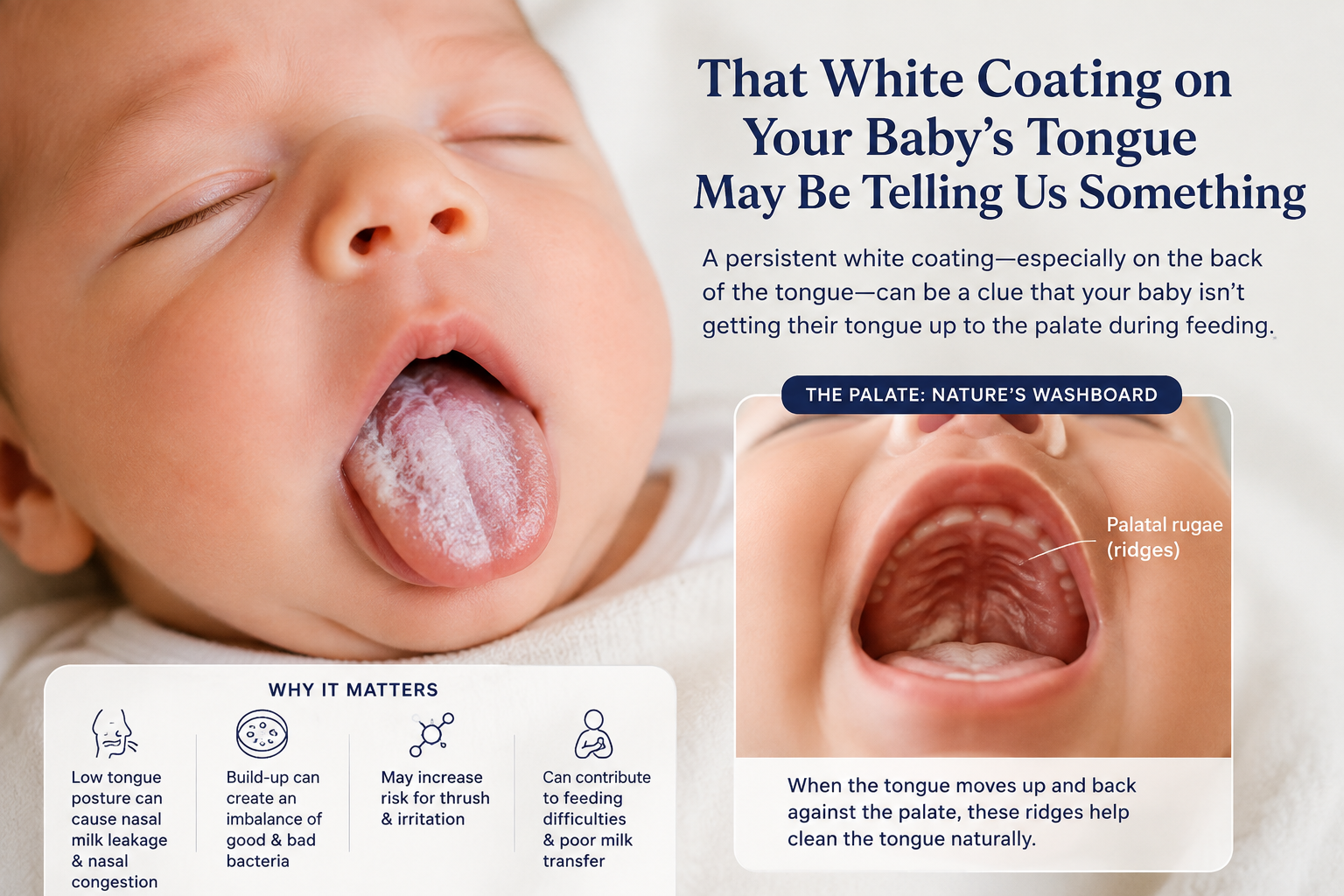
Your baby's palate gives us another clue
Run your own tongue along the roof of your mouth.
You'll feel a series of ridges behind your front teeth. These are called the palatal rugae.
A normally functioning tongue spends considerable time interacting with the palate during sucking, swallowing, and at rest. In our clinical experience, when the tongue is consistently positioned low and the posterior tongue is not adequately elevating during feeding, we often see a heavier coating develop toward the back of the tongue.
The coating itself doesn't diagnose the problem.
It gives us a clue.
What is all that white stuff?
A coated tongue isn't necessarily made entirely of milk.
Tongue coating is a biofilm that can contain food debris, shed epithelial cells, and microorganisms. The surface of the tongue is constantly renewing itself, including cells associated with the tongue's papillae and taste system.
So when we see a white coating, especially one concentrated farther back on the tongue, we don't immediately assume infection.
We ask what might be allowing material to accumulate there.
It isn't automatically thrush
This distinction matters.
White patches in a baby's mouth are frequently labeled “thrush,” yet research suggests appearance alone doesn't always tell the whole story. One study of healthy infants found that babies clinically identified as having thrush-like white patches did not necessarily have Candida albicans when those areas were cultured.
True oral candidiasis is a fungal infection. It can produce white plaques involving the tongue and other oral tissues. Depending on the type, these plaques may wipe away and leave irritated or reddened tissue underneath.
Milk residue, tongue coating, and candidiasis are therefore not interchangeable diagnoses.
So why do we look at tongue function?
This is where things become interesting.
Research using ultrasound has shown measurable differences in tongue position and movement in some babies with feeding difficulties. For example, a study comparing newborns with ankyloglossia to controls found reduced ability to elevate the anterior tongue toward the palate during sucking. More recent ultrasound research has also found relationships between tongue mobility, milk transfer, maternal nipple pain, and feeding biomechanics.
A white posterior tongue coating has not been proven to diagnose these problems.
Still, when we see it alongside other symptoms, we pay attention.
Is your baby clicking during feeds?
Does milk leak from the mouth?
Does milk frequently come through the nose?
Does your baby struggle to maintain suction?
Are feeds unusually long?
Does your baby fatigue while eating?
Is mom experiencing nipple pain?
Does your baby seem frustrated at the breast or bottle?
Is the tongue resting low instead of against the palate?
Now the white tongue becomes one piece of a much bigger story.
Don't just clean the tongue. Ask why.
We aren't interested in diagnosing a baby from the color of their tongue.
We are interested in patterns.
A persistent posterior coating combined with feeding symptoms may be a reason to have the baby's oral-motor function evaluated by a provider trained in infant feeding.
That evaluation should come before assuming the answer is a tongue tie or jumping directly to a procedure.
We want to understand how the tongue moves. How the baby creates suction. How they swallow. How they breathe. Whether they can elevate the tongue toward the palate. And whether they are using the correct muscles or compensating with others.
Sometimes anatomy contributes to the dysfunction.
Sometimes it doesn't.
The goal is to figure out why.
So the next time someone says, “Don't worry, it's just milk,” remember:
Maybe it is.
But your baby's tongue may also be leaving us a clue.
At health:latch, we believe clues deserve questions.
Radically kind, Dr. Thomas ❤️
If you're not sleep-deprived enough and you're apparently interested in learning about tongue movement, here's a great article about it.
